|
Getting your Trinity Audio player ready...
|
The CBT model has been used for many years now, and it has had some rigorous research, evidence and peer reviews to say that this is a good model to follow when a person wishes to change their thoughts (Cognition) and their behaviour. It teaches about this model in my psychoeducational groups with people suffering from addiction. I also use ACT and Mindfulness, which includes meta-cognition (Thinking about Thinking). it is also at the heart of Cognitive Processing Therapy (CPT). You can find this model described in many articles and web pages. So what I have been talking about is nothing new. However, I have yet to see or hear it talked about as a form of creation, creating our now and our coping strategies or personality. We are, in the act of creation through our thoughts and behaviour, to become the person that we want to be from moment to moment.
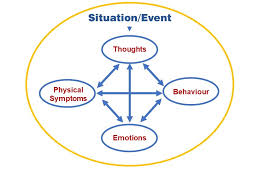
The CBT model uses this diagram to describe it. Thoughts interact with emotions, physical symptoms or sensations and behaviour. Likewise, all other components act, or influence the other components in the model. You could ask if emotions and physiology are in this model as well, why call it CBT? It comes down to what we can control or directly influence with some techniques. We can alter and challenge our thinking (Cognition), and we can more easily control our behaviour, thus Cognitive Behaviour Therapy. However, to change one’s thinking or behaviour, it always helps to have a guide such as a trained counsellor or psychologist.
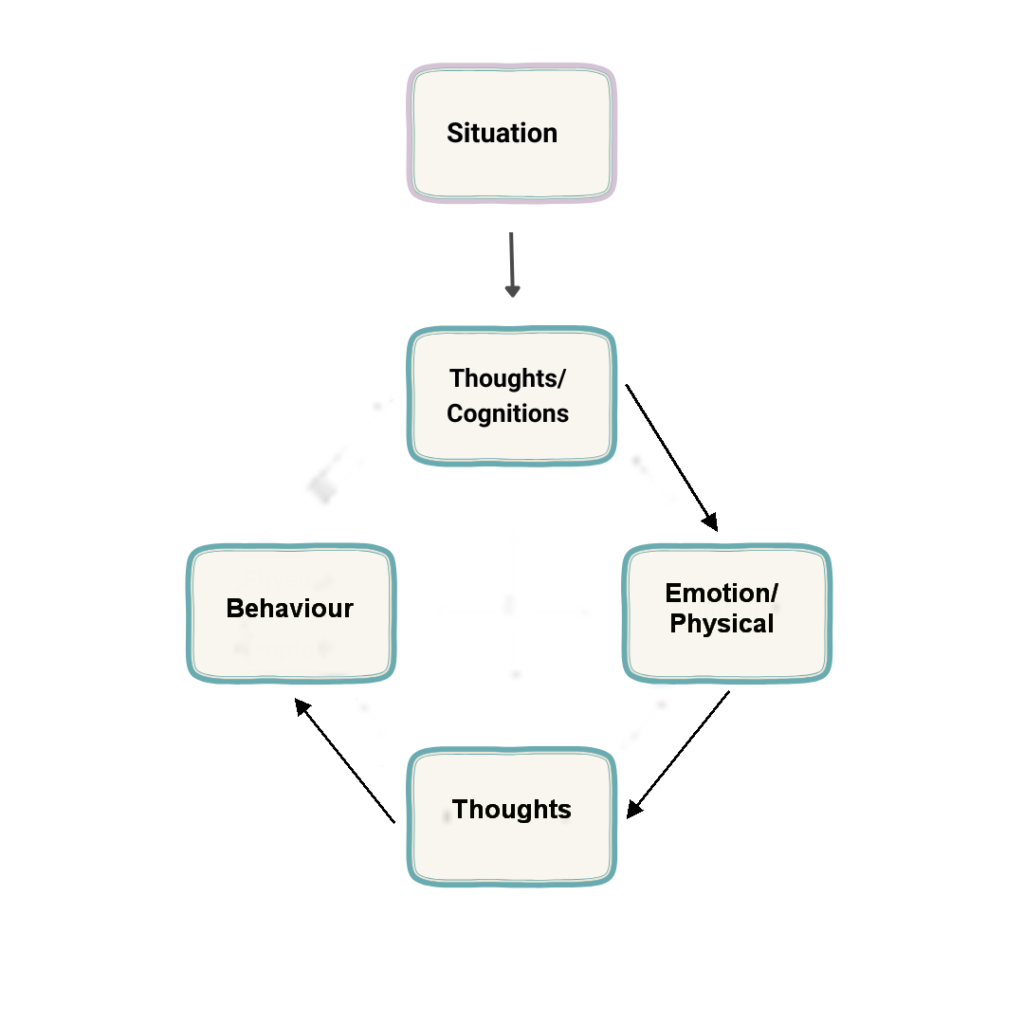
This diagram shows the maintenance cycle of CBT. The situation is anything that comes through the 5 senses: Smell, Touch, Sight, Hearing and Tast. Also, a situation is a cognitive event, wanted or unwanted, meaning a thought, flashback, or intrusive thought. The situation then sparks further thought to give it context or meaning; this meaning then elicits an emotional response accompanied by a physical reaction, such as a racing heart, rapid breathing, sweating of the hands and feet, etc. Further thought is employed to analyse one’s emotion in response to the initial thought, with emotion in context. Here, it is seen as desirable or not, and the appropriate behaviour is given. From behaviour, we wait for the next situation to take place, so that we can go through the cycle again. Based on the outcome, we either keep the thoughts and behaviours that are the maintenance of this cycle, or if we see that the thought or behaviour needs changing, we then create a new cycle.
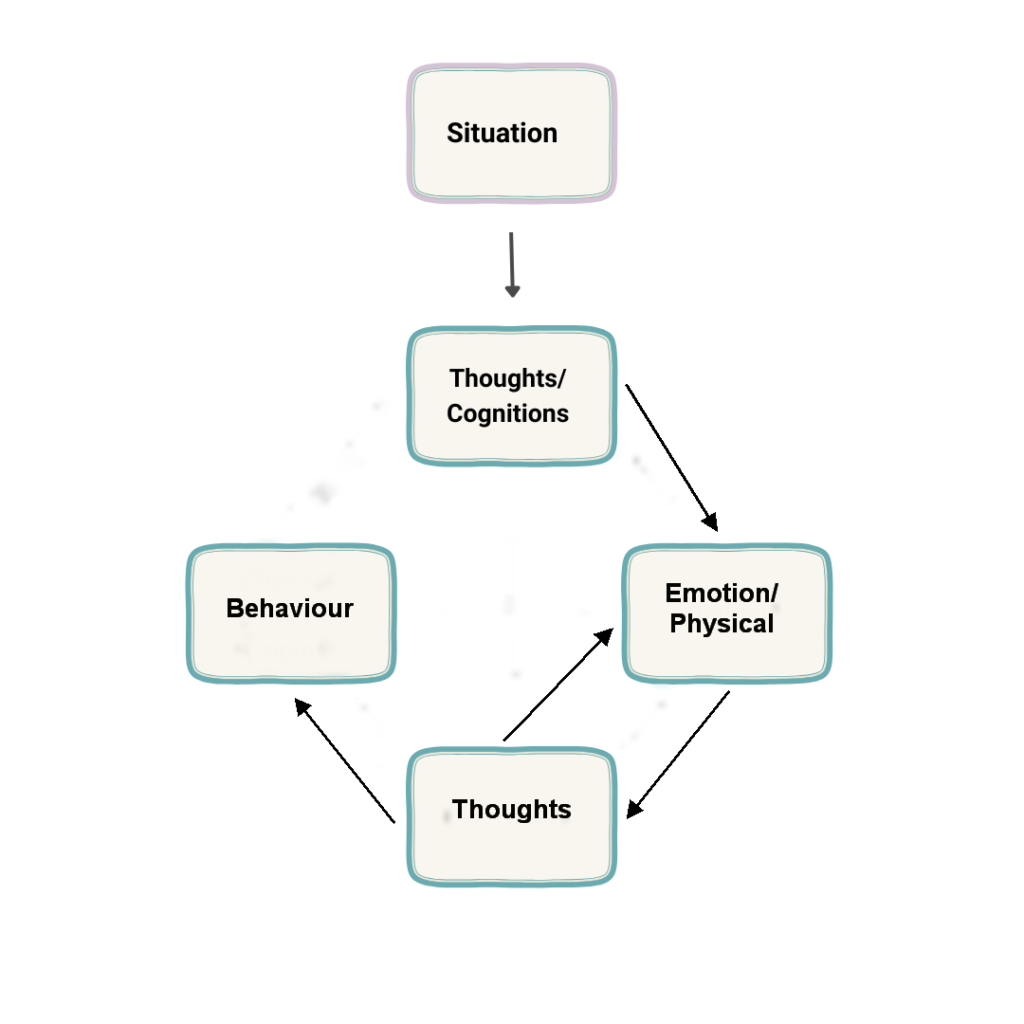
I have added an extra arrow in this diagram. This is the representation of our ruminations or head miles, as my clients call it. When we overthink a situation and start getting stuck in this thought-emotion loop that can potentially last an hour or longer, depending on distractions or the lack thereof that are around us. This can be a major cause of those nights tossing and turning into the early hours of the morning. This thought-emotion loop that we are in is unwanted and causes emotional distress, and it feels never-ending.
The behaviour that we choose is a response to this thought-emotional loop. It is an escape. Some of us will get out of bed and have a cup of hot milk and honey. Then go back to bed and blame the drink as the source of a good sleep, when in fact it was a distraction to the thoughts and a focus for our thoughts.
Others, however, will use a stronger form of substance to help them sleep. A smoke of THC, or an alcoholic drink, can do the same. It is here in the choice, the decision of how to stop the thought-emotion loop that is the form of the creation of our behaviour and then when repeated, becomes the creation of our repeated behaviour, and will last into the future till the decision of using an addictive substance changes to something else. If this thought-emotion loop happens during the daylight hours, we can be more creative to comfort ourselves to keep us distracted from our inner world of trauma and or destress. However, for some, the emotions and thoughts become so strong that they interfere with life. Our relationships become strained, and we become easily irritated and lash out. Hence, the use of substances will be used to escape the loop either by knocking ourselves out at night time or during the day so that the emotions become dull and the thoughts dwell more on the next fix to stop this broken ability to stop the thought-emotion loop. Likewise, we may use a stimulant to help us and prevent us from sleeping, where in the midst of sleep we dream about our trauma, just to wake to have flashbacks and think more about our trauma, which we call Post Traumatic Stress Disorder (PTSD).
But over time, these responses can turn into habits. Each time we react the same way, we strengthen that pattern. Without realising it, we’re building a way of coping that can stick with us long into the future. That’s why I like to think about this process as creation. Because in every moment, we’re not just reacting—we’re shaping who we become. Every thought we challenge, every behaviour we choose, every time we respond differently… we’re creating a new pattern. However, what I deal with from day to day is this pattern having been strengthened for many years, to the point that the client no longer has the Thought-emotion loop and just goes straight to the behaviour of using as soon as the trigger or situation happens. They totally bypass the thought-emotion loop, because they know the loop and avoid the loop by going to the behaviour of substance abuse immediately.
Let’s look at a potential loop in the table below. I will number the thoughts and emotions. So number 1 thought corresponds to number 1 emotion, then you go down one line to the second thought that is triggered by the emotion 1 to bring on thought 2, and this creates the 2nd emotion that then in turn triggers the 3rd thought, and so on, we go till the abyss looks to be a nice place to dwell.
| Thoughts | Emotions |
|---|---|
| 1 – Why did my partner say that in that way | 1 – Anxiety |
| 2 – I think my partner wants to leave me | 2 – fear |
| 3 – I do not want to confront my partner, or it will make it worse. | 3 – More Anxiety |
| 4 – I bet my partner wants to leave me because they met someone new | 4 – Fear and Anger, with more anxiety |
| 5 – I am a useless partner, that’s why they want to leave | 5 – Sadness |
| 6 – I never do anything right | 6 – Sad depression |
| 7 – I only asked a simple question, am I stupid | 7 – guilt |
| 8 – I am stupid, I have been all my life | 8 – Shame |
| 9 – If my partner does not want me, no one wants me. | 9 – Dispare |
| 10 – If they leave me, it is just not worth living | 10 – depression |
| 11 – I may as well go and have a drink to feel better | 11 – relief |
This is where the behaviour starts. This person stands and goes to the drinks cabinet and gets a drink to escape the loop. You can imagine that this is just 11 thoughts. If you are thinking for hours in this loop, many thoughts are repeated, and the emotions get worse. This habitual thought-emotion pattern is now destroying another relationship that you hoped would last. The power of your own imagination and thought pattern has done it, not your partner. This is how we create our reality. By being in fear and anxiety that the relationship is on the rocks, this person has created the situation to bring them the very thing that they are fearful of. Then this person eventually talks to a therapist and complains that this same thing always happens to them, “Why does it always happen to me?” Hence, we have attracted, better still, created, the very thing that we were fearful of.
If we go a bit deeper and look at these thoughts, we can see that the thoughts are a reflection of our beliefs. Then we investigate the habitual thoughts. We can see that at the core of those thoughts is a confidence issue, with the belief that this person belives themself to be stupid. Stupid as a global attack on themself. With time and a lot of self-discovery with the help of worksheets and a counsellor, we can help turn this negative, self-destructive thought pattern into a more adaptive one.
This all sounds fine and dandy. But it is really hard to do and takes time. Just as Frank Hurbit wrote in his novel DUNE. When the mind dictates over the body, the body will follow. However, when the mind dictates over itself, there will always be resistance. or something of that effect.
I can just imagine that you are reading this and some other web pages that say very similar things, and thinking to yourself that you can do it all yourself. This is like asking a goldfish to describe water. I do not see my faults without the effects that it has on others. We are co-creators in this, what we call reality. If we need to grow or sharpen ourselves we need to be around others without fear to challenge us into growth. Just as Steal sharpens steal, brother sharpens brother. This is a painful act that causes the ego to be injured and one’s pride. We need a person to ask the right questions at the right time in the conversation. In CPT, it is called a Socratic Dialogue that challenges the thoughts, beliefs, and stuck points that hold us in the maladaptive thinking pattern.
Now you are asking, how do we change our thoughts or behaviour? Well, just as it states in the therapy, Cognitive Behaviour Therapy. We either challenge our thoughts to think something different or challenge our avoidant behaviour to do something different.
I would like to talk a little about being with others so that we become cocreaters in the now. So we have two maintenance cycles, or patterns of thought in close vicinity. Depending on the goal of each person, this is a meeting for growth, destruction, or to have a good time. This is when one person’s behaviour becomes the situation for the other to go through the thought, emotion, thought, then behaviour, to then become the situation for the other person. This is how we create the emotional thought into being experiential to become our reality in the now, the eternal now.